



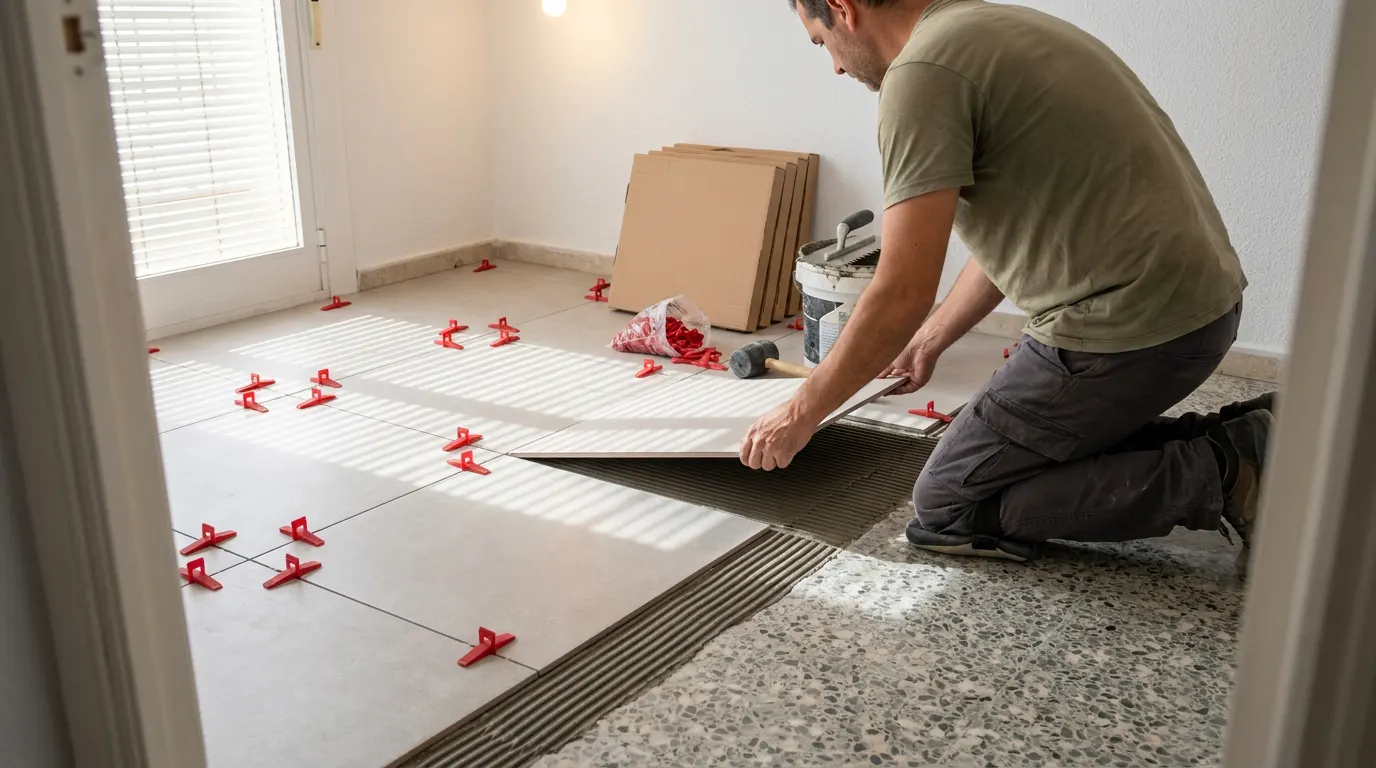
Laying a porcelain floor costs between 25 and 45 € per m² in 2026 with materials and laying for 30 × 60 or 60 × 60 cm tiles, and 40-70 €/m² for large format, according to preciom2; labour alone is 18.17 €/m² according to CYPE. For an 80 m² flat, 2,000-3,600 € before VAT.
These are the market figures used in Spain, before VAT, without lifting the old floor and without skirting. Those three things, which don't appear in the price per metre, can add almost as much as the floor itself, so they are covered one by one further down.
Octo Service is a repair service in Valencia and l'Horta: you write to us, we agree the price before work starts and the job is done by an independent professional who works with us. The figures below come from the market and from the construction price database, with their source linked. They are not our rates.
How much does a m² of porcelain floor cost, laid?
The price per metre depends above all on the size of the tile. The bigger it is, the more the material costs and the harder it is to get it flat.
| Tile format | Materials and laying, €/m² before VAT |
|---|---|
| Glazed stoneware 30 × 60 cm, 3 mm joint | 25-35 € |
| Glazed stoneware 60 × 60 cm, not rectified | 28-38 € |
| Rectified 60 × 60 cm, with levelling wedges | 32-45 € |
| Large format rectified 60 × 120 cm, back-buttered | 40-55 € |
| Large format 80 × 80 or 120 × 120 cm | 50-70 € |
| Valencia and l'Horta | the same ranges; there is no guide with figures of its own for the area |
Source: preciom2, guide to the price of laying porcelain tiles, updated in September 2026 with prices reviewed in April. The guide itself warns of a variation of ±20% depending on quality, the installer and the state of the floor.
If you are looking for the price of tiling a floor (“solar”, in Spanish) or of laying ceramic floor tiles in general, the table works just the same: the glazed stoneware in the first two rows is ordinary ceramic floor tile, and porcelain is the denser version that absorbs the least water.
And to compare with another material: AC4 laminate fitted comes to 18-26 €/m², as explained in how much it costs to fit laminate flooring. It is cheaper and quicker, but it doesn't stand up to water or last as long.
Labour and materials: what you pay for each
The CYPE price database, the one architects and building surveyors in Spain use to cost work, separates the two. For a 20 × 20 cm tile laid with adhesive on a mortar base:
| Type of tile | Tile, €/m² | Total materials, €/m² | Labour, €/m² | Direct cost, €/m² |
|---|---|---|---|---|
| Glazed stoneware | 15.80 € | 20.06 € | 18.17 € | 38.99 € |
| Rustic stoneware | n/a | 24.46 € | 18.17 € | 43.48 € |
| Glazed porcelain | 33.87 € | 39.03 € | 18.17 € | 58.34 € |
| Technical porcelain | 44.03 € | 49.70 € | 18.17 € | 69.23 € |
| Technical large format, 100 × 100 cm | 188.70 € | 202.66 € | 18.53 € | 225.61 € |
Sources: CYPE, glazed stoneware, rustic stoneware, glazed porcelain, technical porcelain and large format, consulted in October 2026. Direct cost before VAT and margin; materials include the adhesive, the spacers and the grout.
Look at the labour column: it is almost the same in every row. In CYPE, laying a metre of floor takes about 0.5 hours of a floor tiler and 0.25 of a labourer, whether the tile is cheap or expensive. What separates a floor at 39 €/m² from one at 225 €/m² is the tile. How many boxes and how many bags of adhesive your floor needs is worked out by the tile calculator.
One caveat: CYPE calculates with 20 × 20 tiles and large volumes of work. With big tiles, the real laying is slower, as the rates below show, and that is why market prices for large format also go up because of the labour.
The three classes, in one sentence each:
- Glazed stoneware. Ordinary ceramic floor tile, absorbs less than 3% water. Fine for almost the whole home.
- Glazed porcelain. Denser, absorbs less than 0.5%. It is the usual choice in flats today.
- Technical porcelain. Absorbs less than 0.1% and is the toughest: the CYPE sheet asks for a breaking load of more than 3,000 N. For areas with heavy foot traffic.
How much does it cost to tile a 60, 80 or 100 m² flat with porcelain?
With the market ranges from the first table, for the formats most common in a home, from 30 × 60 to 60 × 60 cm rectified:
| Area | Floor laid, 25-45 €/m² | If the old one has to come up, 8-18 €/m² | Days of one tiler, 30 × 60 tiles |
|---|---|---|---|
| 60 m² | 1,500-2,700 € | +480-1,080 € | 5-6 days |
| 80 m² | 2,000-3,600 € | +640-1,440 € | 7-8 days |
| 100 m² | 2,500-4,500 € | +800-1,800 € | 8-10 days |
Source: our own calculation with the ranges from preciom2: 25-45 €/m² laid, 8-18 €/m² for lifting the existing floor and a rate of 10-12 m² a day with 30 × 60. Before VAT, without skirting and without levelling.
Two details for reading the table. The days are pure laying time for one tiler; with two people, it takes less. And with large format the pace drops to 4-6 m² a day according to the same guide: 100 m² becomes close to a month for one tiler.
If the kitchen and bathrooms stay as they are, take them off the area: the price goes by the metres that are actually changed.
Lift the old floor or lay over it?
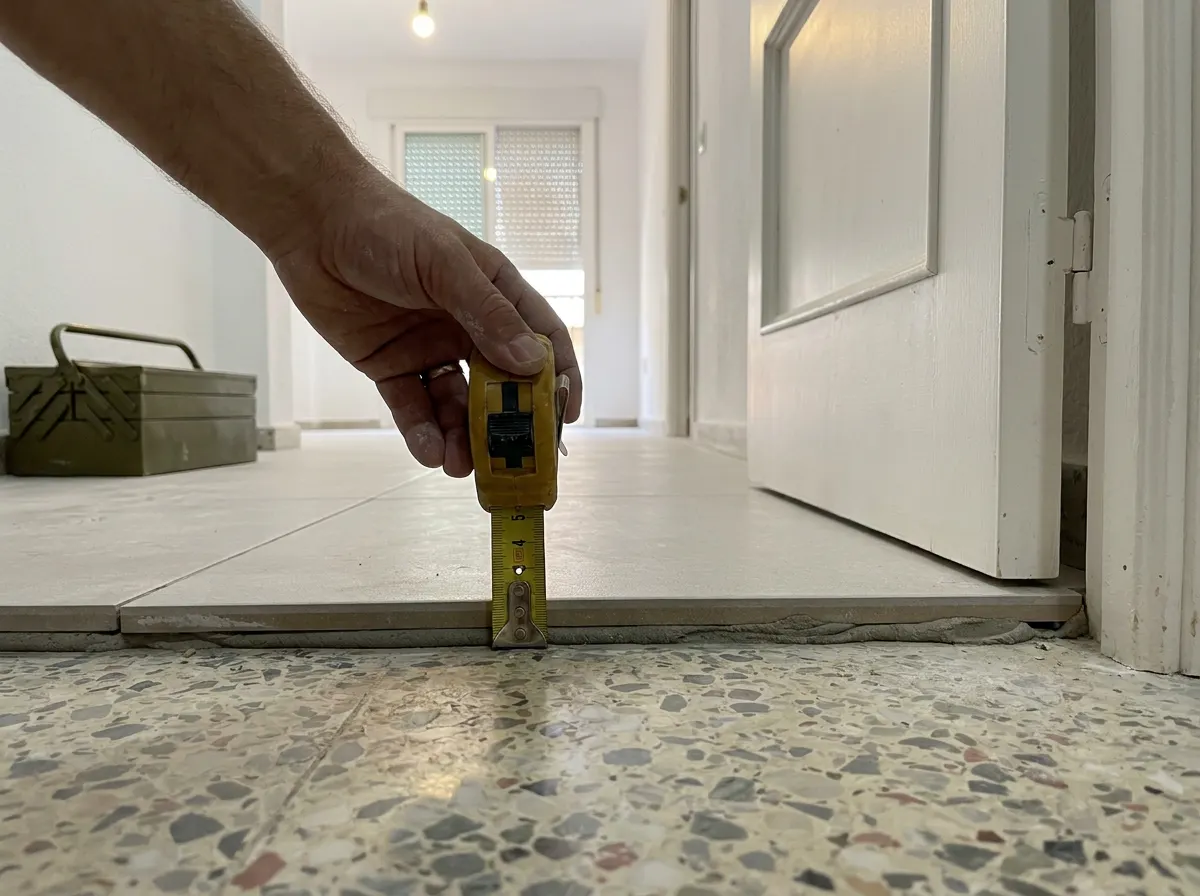
It is the decision that moves the most money after the tile.
Lifting. Breaking up a ceramic floor by hand and loading it into the skip costs 14.73 €/m² in CYPE; the preciom2 guide gives 8-18 €/m². In 80 m² that is more than a thousand euros, several days of noise and dust, and rubble to get out of the flat.
Laying over it. Porcelain can be stuck over old terrazzo or stoneware with a suitable adhesive, as long as the base is firm, flat and has no tiles that sound hollow when tapped. You save the demolition and almost all the rubble.
What do you lose? Height. A CYPE tile is 10 mm thick, and large format 12 mm; with the adhesive, the floor rises a little over a centimetre. That means checking three things:
- The doors: if they rub, they have to be trimmed at the bottom. If they are old as well, look first at what it costs to replace the interior doors, because it is sometimes worth doing it in the same job.
- Where it meets rooms you are not changing, which is solved with a transition strip.
- The shower tray or the toilet, if the new floor goes into the bathroom.
In Valencia many flats still have their original terrazzo, and it is usually a good base if it is intact. If half the tiles sound hollow, there is no shortcut: it comes up.
Does it need levelling first?
Adhesive takes up small differences, but not a sagging floor. If you lay a two-metre straightedge on it and see light underneath, it has to be evened out before laying.
A thin 2 mm layer of self-levelling compound, with its primer, costs 9.46 €/m² in CYPE; preciom2 gives 8-15 €/m² depending on the state of the base. With 60 × 120 tiles or larger it is almost compulsory: a long tile on a wavy floor ends up with its corners raised, and you feel it underfoot and see it in low-angle light.
Skirting, joints and rubble: what the m² price leaves out
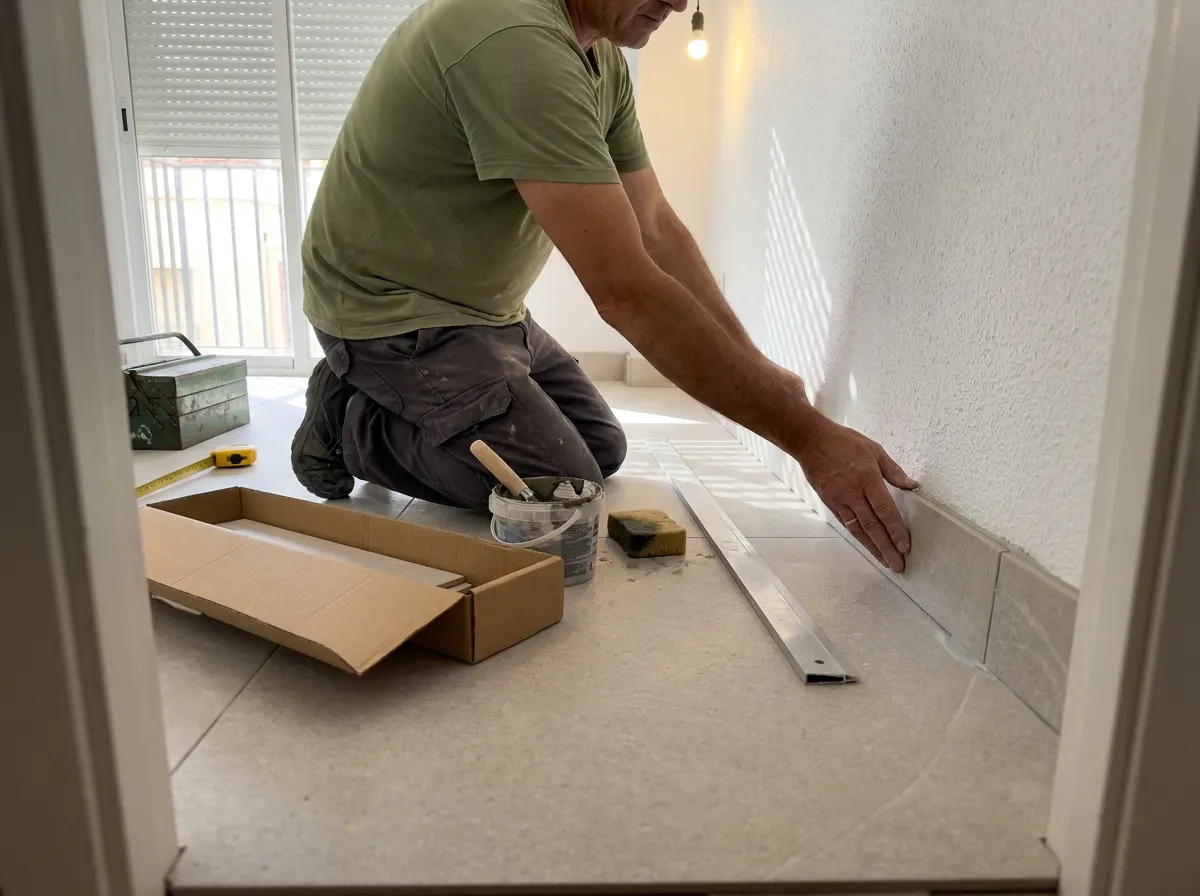
These are the items that turn a 2,000 € quote into a 2,800 € one.
Skirting. It is charged per linear metre of wall, not per metre of floor. An 8 cm ceramic skirting fitted costs 8.28 €/m in CYPE, of which 5.31 € is labour. Removing the old skirting is another 1.76 €/m. Measure the walls of the rooms you are changing, leaving out the doors, and multiply.
Joints and large format. Rectified tiles, with machine-cut edges, allow very thin joints, but they need levelling wedges and a very flat floor. According to preciom2, rectified costs 10-25% more than the same tile unrectified, and the tiler lays fewer metres a day. A thin joint looks very clean; the downside is that any unevenness shows.
Rubble. If you lift the floor, the rubble goes into a skip: a 7 m³ one with delivery, hire and collection costs 99.53 € in CYPE. If it goes on the street, ask who deals with the town hall permit for it.
Spare material. You have to buy extra tiles for cuts and breakages: CYPE counts 5% extra in every item in the table. And keep a box: in ten years' time, that tile will probably no longer be made.
What VAT applies, and is a permit needed?
VAT can be 10% instead of 21% if the work is in your home, the building is more than two years old and the materials supplied by whoever does the work don't exceed 40% of the taxable base. The Spanish Tax Agency sets this out.
With porcelain, the third condition is almost always broken: in the CYPE table, the material is two thirds of the price per metre of glazed porcelain. If whoever lays it also supplies the tiles, the whole invoice goes at 21%. If you buy them yourself, their invoice is almost only labour and can go at 10%.
On permits: in Valencia city, replacing the floor of your home is done with a declaración responsable for building work, with a fee of 140.90 € if the work doesn't exceed 6,010.12 € and the ICIO construction tax of 4% of the works budget. In the rest of l'Horta each town hall has its own figures.
Three questions before accepting a quote
- Does the price per m² include the tiles or only the laying? And if it includes them, exactly which tile is it?
- Are lifting the old floor, levelling, skirting and the skip included? They are four lines that should be listed separately.
- How many metres is it counting? Ask for the area that was measured, room by room.
A fixed price before anything comes up
At Octo Service we agree a fixed price in writing before work starts. You send us the metres, photos of the current floor and the tile you want, we send back the total with VAT broken down by item, and if it suits you, the work is done by independent professionals who work with us in Valencia city and the towns of l'Horta. If something turns up when the floor comes up, you get a new proposal before anything goes further.
What the floor and wall tiling service covers is on the tiling in Valencia page. If you are also going to change the tiles in the bathroom, the numbers are in how much it costs to tile a bathroom. And if you are not sure we reach your street, check do we reach your home?.