





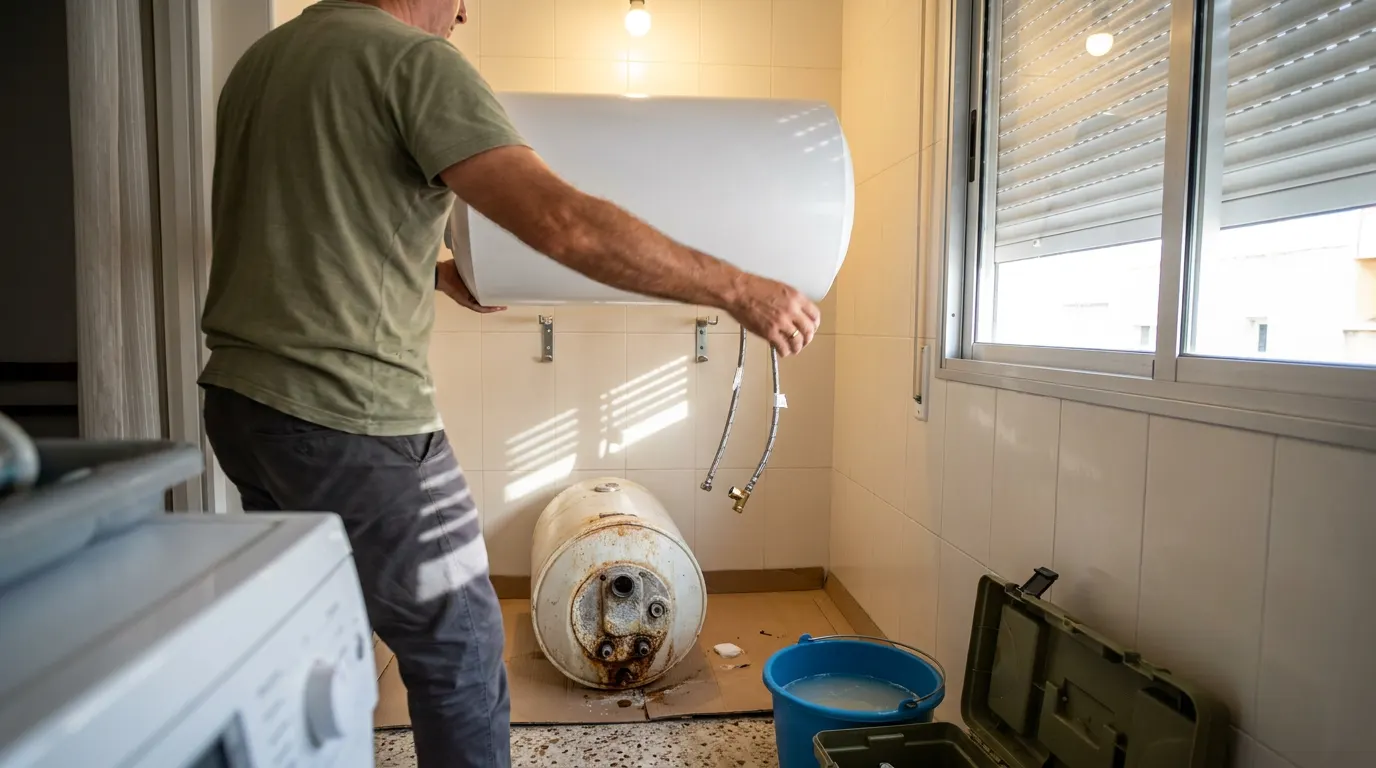
Replacing an electric water heater (termo) in Spain costs between about 380 and 800 € in 2026 with the unit, labour and VAT: around 400-640 € for an 80-litre one and 560-770 € for a 100-litre one. The unit takes more than half; labour runs from 80 to 250 € including removal of the old one.
That's what you'll pay if the professional supplies everything. Two things move the figure more than the litres: the brand of the unit and who buys it, because that decides whether the invoice goes at 10 or 21% VAT (IVA).
Below is the breakdown, with where each number comes from. The ranges are a guide to the 2026 market, not our rates.
How much does it cost to replace an electric water heater in 2026?
To avoid making up unit prices, we use the CYPE Generador de Precios, the database architects and builders in Spain use to price construction work. Its figures are direct cost, before VAT and without the margin of whoever installs it for you, so they're the floor, not the ceiling.
| Water heater (CYPE reference) | Unit, before VAT | Hoses, valves and safety valve | Market labour | Guide total with 21% VAT |
|---|---|---|---|---|
| 50 L, high-end (Vaillant eloSTOR pro 50) | 260 € | 34 € | 80-250 € | 450-660 € |
| 75 L, generic unbranded | 203 € | 34 € | 80-250 € | 380-590 € |
| 80 L, mid-range (Junkers or Saunier Duval) | 219-245 € | 34 € | 80-250 € | 400-640 € |
| 100 L (Saunier Duval) | 349 € | 34 € | 80-250 € | 560-770 € |
| 120 L (Vaillant eloSTOR pro 120) | 375 € | 34 € | 80-250 € | 590-800 € |
| Valencia and l'Horta | the same units | the same | 80-250 €; in the towns, ask whether there's a separate call-out fee | as in the row for your litres |
Source: unit, hoses and valve from the CYPE Generador de Precios, linked row by row; labour from the 80-250 € range Cronoshare publishes in its guide “¿Cuánto cuesta instalar un termo eléctrico?” for replacing an electric water heater (5 January 2026). Total with 21% VAT on everything, rounded to the nearest ten.
Look at the first row. A high-end 50-litre water heater costs more than a mid-range 80-litre one. The brand, the type of element and the years of tank warranty weigh as much as the capacity, so comparing “an 80” with “an 80” without looking at the model doesn't tell you much.
Labour is the most variable part. CYPE allows about 0.8 hours of a qualified plumber and an assistant to hang and connect a new water heater, which at their labour cost comes to between 28 and 42 €. But that doesn't include getting to your home, draining the old one (a full 80-litre water heater weighs around 100 kilos), bringing it down, taking it to the recycling centre (punto limpio), or the company's margin. That's why, in practice, a replacement is charged at between 80 and 250 €.
If you already know what you have and want a fixed number, send us a photo of the water heater and its rating plate: get a plumbing quote.
What's in the price and what isn't
A properly drawn-up quote for replacing a water heater separates five things.
The unit. With model, litres and type of element. If it only says “water heater 80 L”, ask for the brand and exact model before accepting.
The fittings. Two new flexible hoses (latiguillos), two shut-off valves and a safety valve. The safety valve isn't optional: it's what lets water out when the pressure rises as the water heats. CYPE includes it in all its items, and its spec sheet has it set at 8 bar. Reusing the old one, full of limescale, is the classic way to save 6 € and end up with a problem.
The labour. Draining, disconnecting, taking down, hanging the new one, connecting, filling, bleeding and checking nothing drips.
Removal of the old one. Many include it, others charge for it separately. Ask.
The VAT. We explain it further down because that's where people lose the most money without noticing.
What's not usually included: changing the brackets if the wall is hollow brick and the new unit is heavier, moving the water heater to another wall (that means redoing the pipes and the socket), or changing the electrical circuit if the RCD (diferencial) trips. If your current water heater isn't heating and you don't know why, before buying another one try our water heater not heating check: sometimes it's the RCD or the thermostat, not the whole unit.
What size does the water heater need to be?
The OCU's buying guide to electric water heaters (the OCU is Spain's main consumer organisation) works on about 35 litres per person per day and gives this table:
| People at home | Recommended capacity |
|---|---|
| 1 | 50 L |
| 2 | 80 L |
| 3 | 100 L |
| 4 | 150 L |
| 5 | 200 L |
The rule works as a starting point. If you all shower one after another in the morning, go up a size. If routines are staggered, the exact size is enough, and you also spend less keeping water hot that nobody uses.
Watch the space. A 100-litre water heater is usually around a metre tall (the Saunier Duval in the table, 1,000 mm with a 440 diameter) and an 80-litre one about 87 cm. If the old one sits in a cupboard on the utility balcony (galería), measure the cupboard before choosing, not after.
How long does an electric water heater last, and why less in Valencia?
The OCU, in the same guide, gives a typical life of 5 to 10 years, which can reach 15 with good maintenance. What decides whether your water heater stops at 6 or makes it to 12 is the water.
Valencia's water is hard. The OCU, in its report on water hardness, uses it as an example of hard water and classes as “very hard” anything above 40 French degrees; soft is anything below 12. The exact figure for your street is on SINAC, the Ministry of Health system where the analyses for each supply zone are published.
For the water heater this has three consequences.
Limescale sticks to the element. The OCU estimates that a water heater loses around 10% of its efficiency for every millimetre of limescale built up. It keeps heating, but takes longer and uses more electricity.
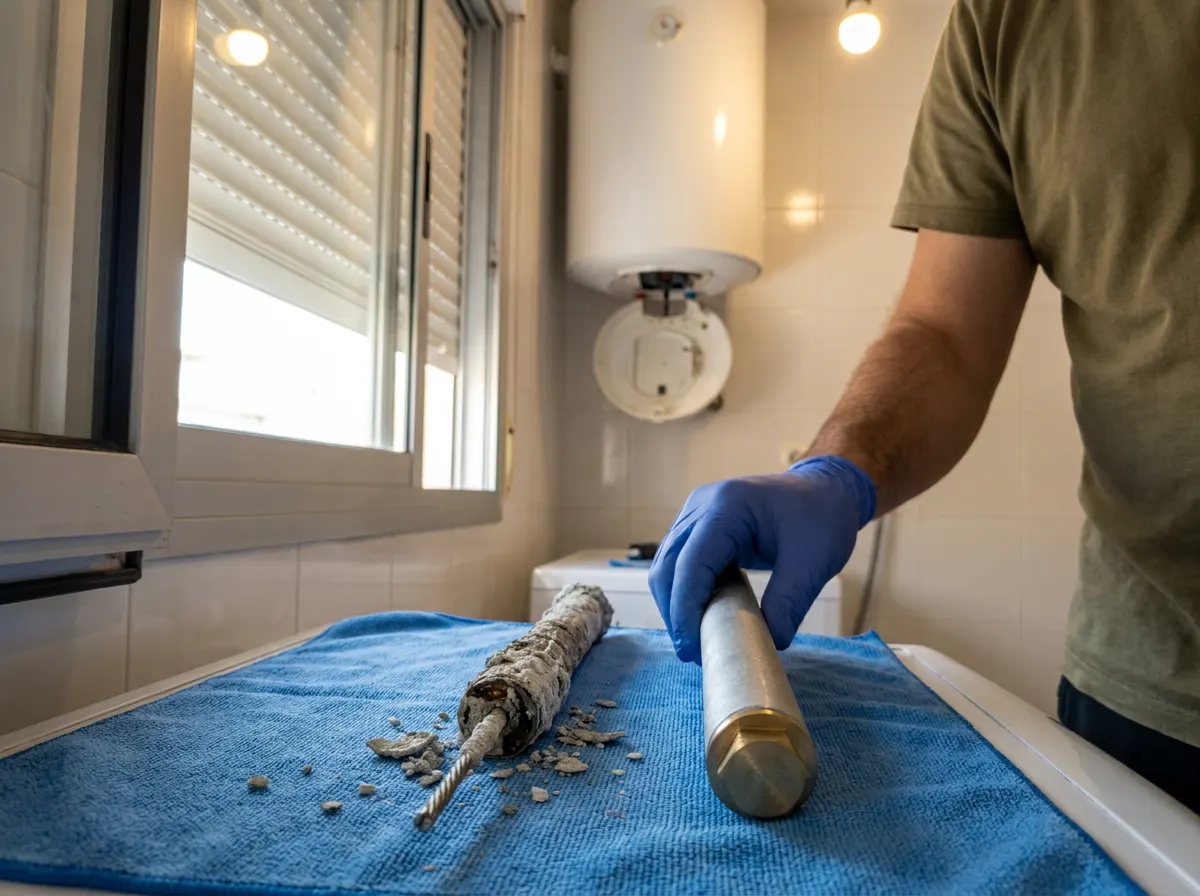
The magnesium anode wears away sooner. It's a rod that sacrifices itself so the tank doesn't rust. Once it's gone, the tank starts to rust, and that can't be fixed. The OCU recommends replacing it at least every two years, more often with hard water.
The element matters. There are two types: immersed, in direct contact with the water, and sheathed (also called ceramic or steatite), housed inside a casing. The OCU recommends the sheathed type for hard-water areas, because the limescale doesn't touch it directly. In Valencia, if you can choose, choose sheathed.
Repair or replace the water heater?
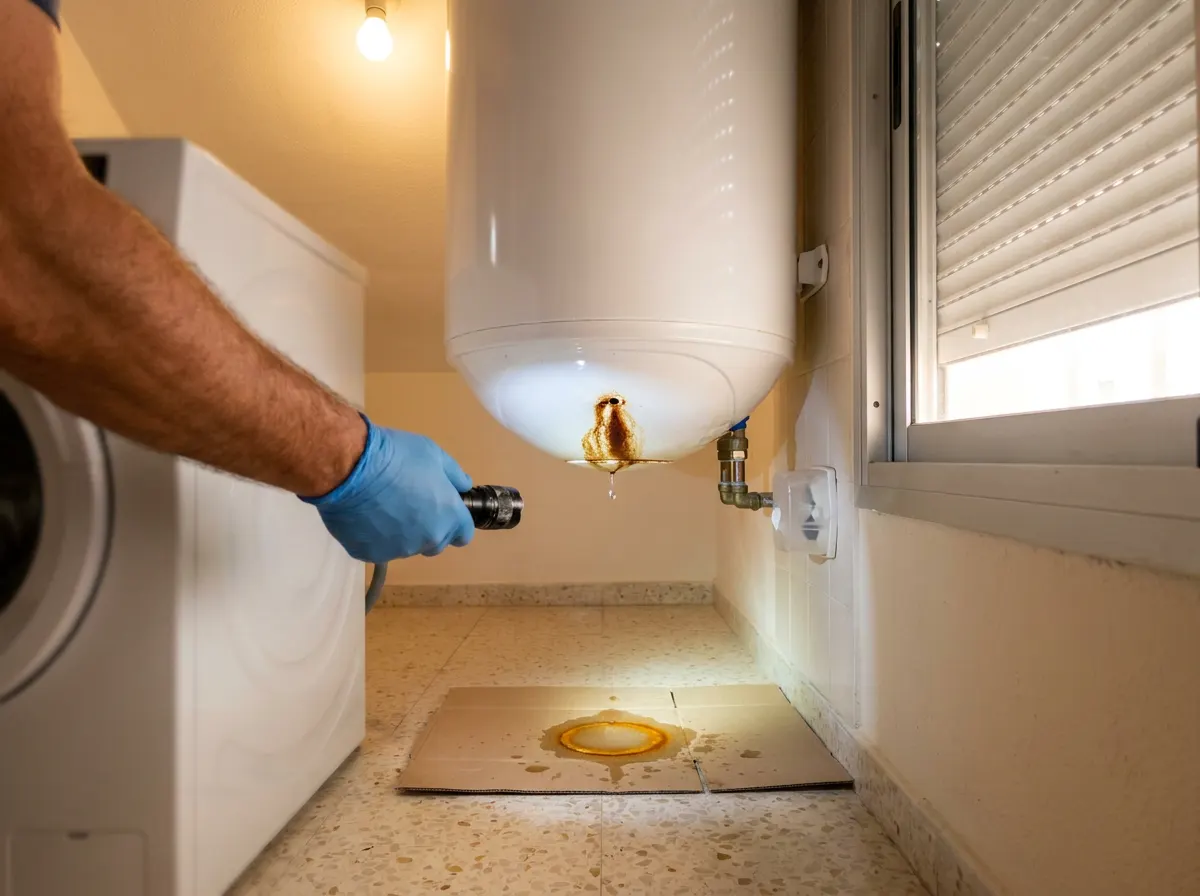
The short rule: if the tank leaks, it gets replaced; if a part fails, look at its age.
Replace it, no second thoughts, when:
- Water or rust is coming from the bottom of the tank, not from a fitting. A pitted tank can't be welded.
- The water heater is more than 8-10 years old and, on top of the fault, has been slow to heat for a while.
- The hot water comes out brown, rusty, all the time: it's the tank rusting from the inside.
Repairing usually pays when:
- The water heater is less than 5 or 6 years old.
- What's failing is the element, the thermostat or the safety valve, parts that can be changed without touching the tank.
- It drips from a fitting or the valve, not from the tank.
Before paying for anything, check the warranty. Manufacturers give the tank its own warranty, longer than the one on the appliance: Thermor, for example, gives 3, 5 or 7 years depending on the protection system. If the tank fails within that period, the call goes to the brand's technical service, not to a plumber.
What VAT applies to replacing a water heater: 10 or 21%?
Almost always 21%. And there's real money here.
Repair or renovation work in a private home can go at 10% VAT, but with one condition: the cost of the materials supplied by the professional can't exceed 40% of the taxable base. It's in the Agencia Tributaria's FAQ on works and repairs to property, which uses precisely the example of replacing a boiler: the appliance goes over 40% and the whole invoice goes to 21%. The same happens with a water heater.
There's another route. If you buy the water heater yourself and the professional supplies only the labour, there are no materials on their invoice and they can apply 10%. On an 80-litre water heater with 180 € of labour, the difference between 10 and 21% on that labour is about 20 €. It's not a fortune, but the catch is that you pay for the unit at 21% in the shop and you deal with the shop yourself for the appliance warranty.
Our practical advice: if you already know which water heater you want, ask for both prices. Unit included, and labour only. Then decide with the numbers in front of you.
Electric water heater, gas water heater or heat pump
If you're replacing the water heater, it's the moment to ask yourself whether you want another one. A short summary, with no sales pitch:
| System | When it makes sense | What to bear in mind |
|---|---|---|
| Electric water heater (termo) | flat without gas, replacement in the same spot | the cheapest to install; uses more electricity than the other two options |
| Gas water heater (calentador) | there's already natural gas or butane at home | endless hot water; installed and serviced by a certified gas installer, never by a handyman |
| Air-source heat pump (aerotermia) for hot water | a home with room for the unit and an owner who wants a lower bill | the upfront investment is considerably higher; the IDAE explains in its guide why a heat pump uses less energy |
Switching from an electric water heater to a gas one where there's no gas, or to a heat pump, is no longer “replacing the water heater”: it's a different job, with a different quote. If you're considering it, say so from the start so it gets priced separately. If you already have gas at home, what it costs to replace the gas water heater is in how much it costs to install a gas water heater.
How long it takes and what you need to get ready
A like-for-like replacement is done in one visit. Hanging and connecting takes less than an hour; draining the old one, especially if it's 100 litres or sits in a high cupboard, is what eats up the time.
So it doesn't drag on:
- Clear the access: empty the cupboard on the utility balcony, move the washing machine out of the way if it's underneath.
- Find the main stopcock (llave de paso) and check that it closes. If it's seized with limescale, say so beforehand.
- Take a photo of the old water heater's rating plate (litres, power) and of the wall where it hangs.
With those three photos, any professional can give you a price without coming round first.
Ask for a fixed price before anyone comes round
At Octo Service we agree a fixed price in writing before work starts. You send us photos of the water heater and its rating plate, we come back with the total amount with VAT, and if it suits you, an independent professional who works with us in Valencia city and the towns of l'Horta goes round. If something turns up when it's taken apart that couldn't be seen before, you get a new proposal and you decide.
If you want to compare with prices for other plumbing jobs, there's the guide to what a plumber costs in Valencia and the plumber in Valencia page. And if you're not sure we reach your street, check it on do we reach your home?.