



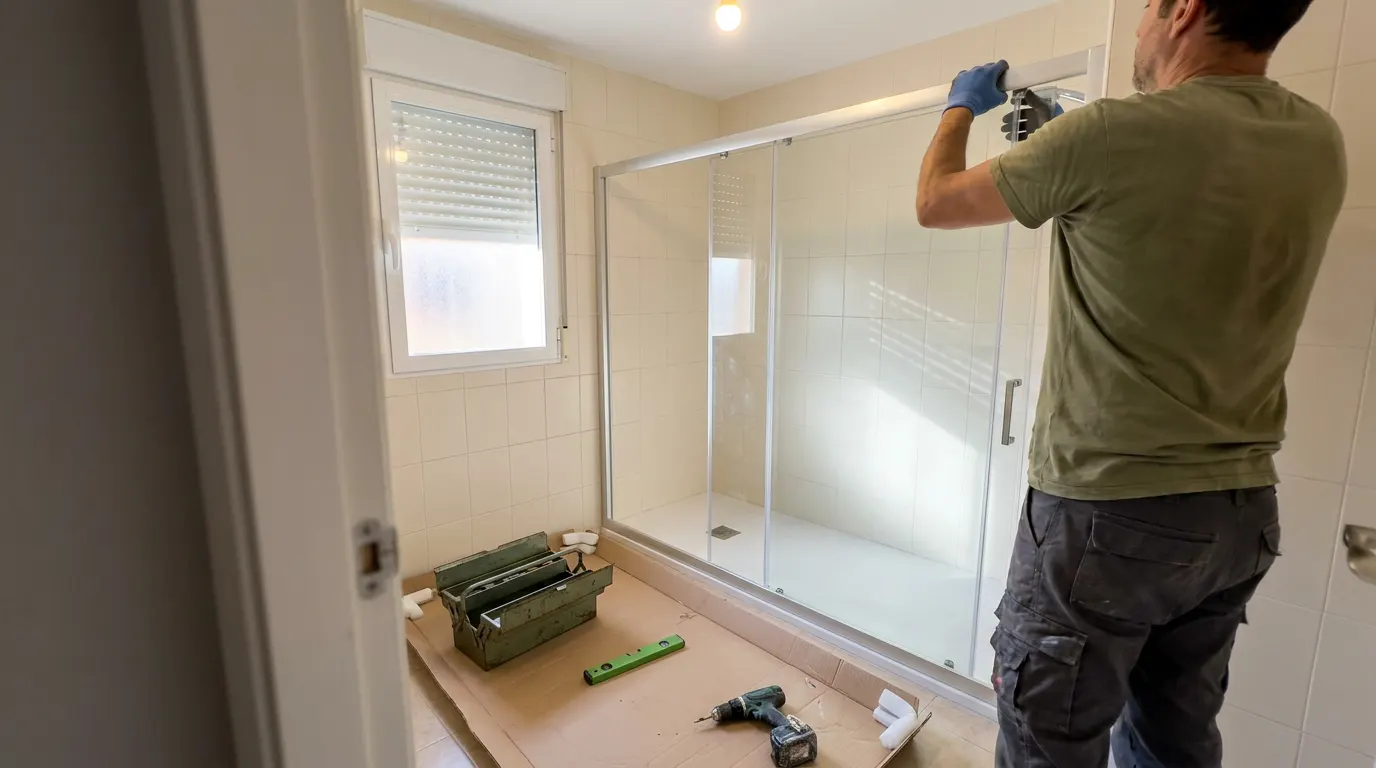
Fitting a shower screen costs between 50 and 250 € in labour in 2026, according to estimates from El Español and the manufacturer Pabaño; the CYPE price database works it out at 121.50 €. The screen itself is paid for separately: from 200 to 1,000 € or more. Installed, with a standard screen, the total is around 500-900 €.
The figure that matters most here is the first one, because more and more people buy the screen themselves and are only looking for someone to fit it. It is what we see in the requests we get: the screen is in a box in the hallway and the question is “how much will you charge me to put it in?”.
Octo Service is a repair service in Valencia and l'Horta: you write to us, we agree the price before work starts and the job is done by an independent professional who works with us. The figures below come from the market and from the construction price database, with their source linked. They are not our rates.
How much does it cost to fit a shower screen in 2026?
Let's separate the two things you pay for: the work of fitting it and the screen itself.
| What you pay for | Guide price | Source |
|---|---|---|
| Labour for fitting a standard shower screen | 50-130 € | El Español, December 2025 |
| Labour of a fitter, standard installation | 80-250 € | Pabaño, manufacturer, April 2026 |
| Sliding front screen with fixed side panel, for a shower | 2.47 h of a fitter and 2.47 h of a labourer: 121.50 € | CYPE |
| Sliding front screen with fixed side panel, for a bath | 2.69 h of a fitter and 2.69 h of a labourer: 132.05 € | CYPE |
| Full installation, not counting the screen | 150-500 € | Pabaño |
| The screen alone | 200-1,000 € or more; acrylic from 200 €, tempered glass from 400 € | Acierto, May 2026 |
| Standard screen already installed, everything included | 500-900 € | El Español |
| Valencia and l'Horta | the same ranges; in the towns, ask whether travel is charged separately | n/a |
Sources: El Español, the price of fitting a shower screen, Pabaño, how much it costs to fit a shower screen, CYPE, shower screen and bath screen, and Acierto, replacing the bath with a shower, consulted in October 2026. All in Spanish.
Why are the labour ranges so different from each other? Because they don't count the same thing. The 50-130 € one is fitting a standard screen in a prepared opening. Pabaño's 150-500 € is the whole installation, not counting the screen, and the top end covers cases with more work. What usually separates one case from another is what surrounds the fitting: taking down the old screen, removing the old silicone and adapting the profile to a crooked wall. When you are given a price, ask whether that is included.
And one fact that helps read any quote: CYPE, the database used by architects and building surveyors in Spain, counts two people for about two and a half hours. A pane of 6 or 8 mm glass almost two metres tall is much easier to handle with two, and the door has to be hung and adjusted with the glass in the air.
How much it costs by type of screen
They are not all fitted the same way. These are the ones most often installed in a flat, from the simplest to the one that takes the most work:
| Type | What it is | What makes fitting harder | Price of the screen |
|---|---|---|---|
| Fixed or walk-in | A single glass panel, no door, with a bar to the wall or ceiling | Not much: one profile and one bar; it needs thick glass | hinged and fixed ones from about 300 € |
| Sliding front | One or two panels that slide over a fixed panel, across the front of a tray between walls | Hanging the panels and adjusting the rollers so they don't rub | from 200 € in acrylic, from 400 € in tempered glass |
| Hinged | A door that opens outwards on hinges | Needs clear space in front and well aligned hinges | hinged and fixed ones from about 300 € |
| Corner | Two fronts in a corner, for square or quadrant trays | Two walls that are almost never square | depends on size and glass |
| Bath screen | A fixed or sliding panel on the edge of the bath | The edge of the bath isn't always level | depends on size and glass |
Price source: Acierto, which gives as a starting point about 200 € for folding screens, about 300 € for hinged screens and fixed panels, 200 € for acrylic ones and 400 € for tempered glass ones. The rows without a figure have no published range we can link to.
If you are taking out the bath to put in a tray, the screen is only one of the items: the rest is in how much it costs to replace a bathtub with a shower tray.
6 or 8 mm glass and the EN 14428 standard
Almost all the glass shower screens sold in Spain are tempered safety glass. It is glass treated so that, if it breaks, it does so in small pieces with no sharp edge, instead of in shards. There is a European standard that sets the tests a shower screen has to pass: EN 14428.
An example of what is tested: a technical sheet from the AIDIMME technology institute records the tests on a 6 mm glass screen under UNE-EN 14428:2016 + A1:2019: general requirements, resistance to repeated use of the door, stability and water retention.
6 or 8 mm? Manufacturers use both depending on the part. The manufacturer Profiltek fits 6 mm safety glass in one sliding range and 8 mm in another, and both declare that they meet EN 14428. The practical rule:
- 6 mm for panels that move, such as sliding and hinged ones. They weigh less and the rollers and hinges suffer less.
- 8 mm for large fixed panels and walk-in screens, which stand upright with little support.
For you, the useful part is this: ask for the screen's data sheet to cite EN 14428 and for the glass to be tempered or “safety” glass. If it doesn't say so, don't buy it. And in Valencia, with the hard water we have, glass with an anti-limescale treatment is much easier to clean; you can check the hardness in your area with Global Omnium.
What needs doing before anyone comes
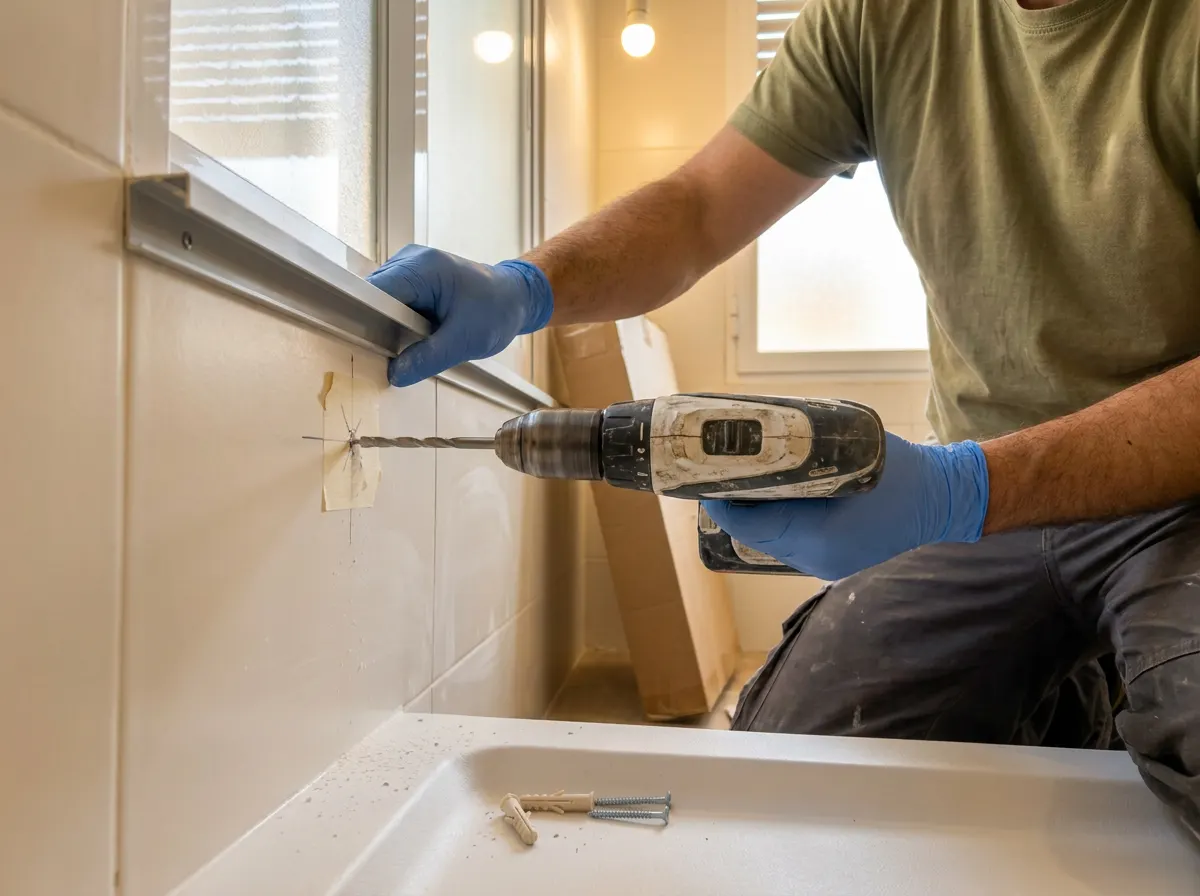
The screen is the last thing fitted in a bathroom. The CYPE specification says it plainly: before starting, check that the base is completely finished. In practice, that means three things.
The wall tiled and the tray in place. The screen is screwed to the wall and rests on the tray or on the edge of the bath. If a tile is missing or the tray isn't sealed yet, it can't be fitted.
Measurements of the opening at three heights. Measure the width at the bottom, in the middle and at the top. Walls are almost never plumb, and the difference between the three measurements is what the screen's adjustment profile has to take up. Manufacturers state how much each model takes up: in Profiltek's data sheet, for example, the HADA PLUS range adjusts 20 mm on each side. If your opening falls outside that margin, a standard screen won't fit properly and you need one made to measure.
Drilling the tiles. Each profile is fixed to the wall with plugs, so holes have to be made in the tiles. With a ceramic or porcelain bit, without hammer action and with masking tape over the spot so it doesn't slip. If the tile is old and brittle, whoever fits it should warn you beforehand about the risk of one cracking.
Made to measure or standard
A standard screen is made in fixed widths and adjusted to the opening with the profile. A made-to-measure one is made for your exact opening.
When the made-to-measure one is worth it:
- The opening falls outside the adjustment margin of the standard profile.
- There is a sloping ceiling, a column or a step in the tray.
- You want a fixed panel of thick glass with no visible profiles.
What changes, apart from the price, is the timetable. The made-to-measure one needs a visit to measure, a manufacturing time and another visit to fit it. During those days the shower works, but it splashes. El Español mentions quotes over 1,000 € in special cases or with premium finishes; the difference is the screen, not the fitting.
When can the shower be used?
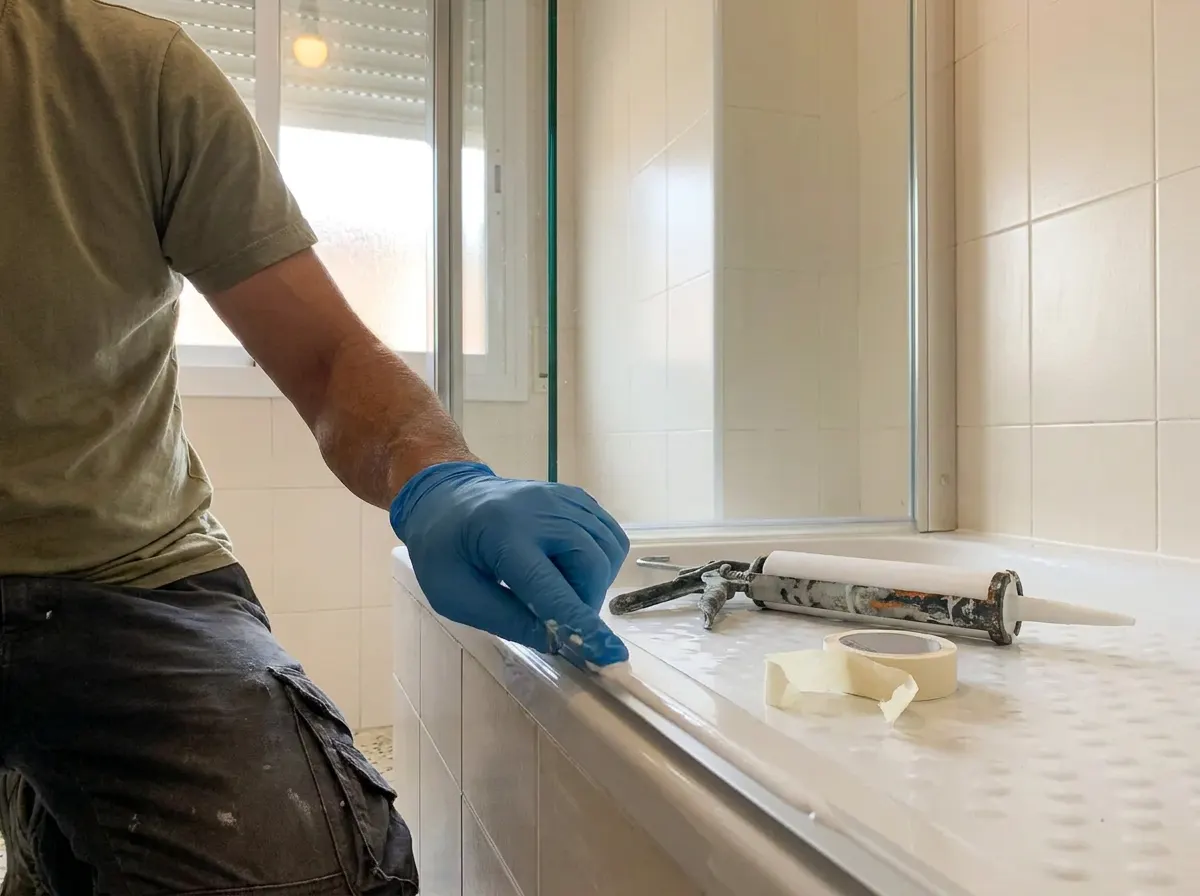
The last step is sealing with sanitary silicone the joint between the profiles and the wall and between the bottom profile and the tray. That silicone has to cure before it gets wet.
A reference figure: in the technical data sheet for Sika Sanisil, a very common sanitary silicone, curing advances 3 mm every 24 hours at 23 °C and 50% humidity. A normal bead takes about a day; in a cold bathroom or with a thick bead, a bit longer. Each silicone states its time on the cartridge, and that is the one that counts.
If the old screen had blackened silicone, it has to be removed completely before the new one goes on. Sealing over the old one is the quickest way to have mould again within a few months.
What VAT applies to fitting a shower screen?
If you buy the screen and only pay for the fitting, the invoice from whoever installs it normally carries 10% VAT: it is a repair in your home and the material they supply, a few screws and silicone, doesn't reach 40% of the taxable base. The conditions are in the Spanish Tax Agency's FAQ on building work in properties.
If whoever fits it also supplies the screen, the glass usually outweighs the labour, it goes over 40% and the whole invoice goes at 21%. That is why, in a full bathroom renovation, buying the screen yourself is one of the decisions that saves the most.
Before asking for a price
Four photos and a few measurements are enough to get a price without a visit:
- The whole opening, from the front.
- Each side wall, with the tiles.
- The tray or the edge of the bath.
- The screen's box, if you already have it, with the model and the measurements.
- And the width of the opening measured at the bottom, in the middle and at the top.
A fixed price to fit your shower screen
At Octo Service we agree a fixed price in writing before work starts. You send us the photos and measurements, we send back the total with VAT, and if it suits you, an independent professional who works with us comes to your home in Valencia city or your town in l'Horta. If something turns up when the old screen is taken down, you get a new proposal and you decide.
Fitting a shower screen is part of what the handyman in Valencia service covers. And if you are not sure we reach your street, check do we reach your home?.