





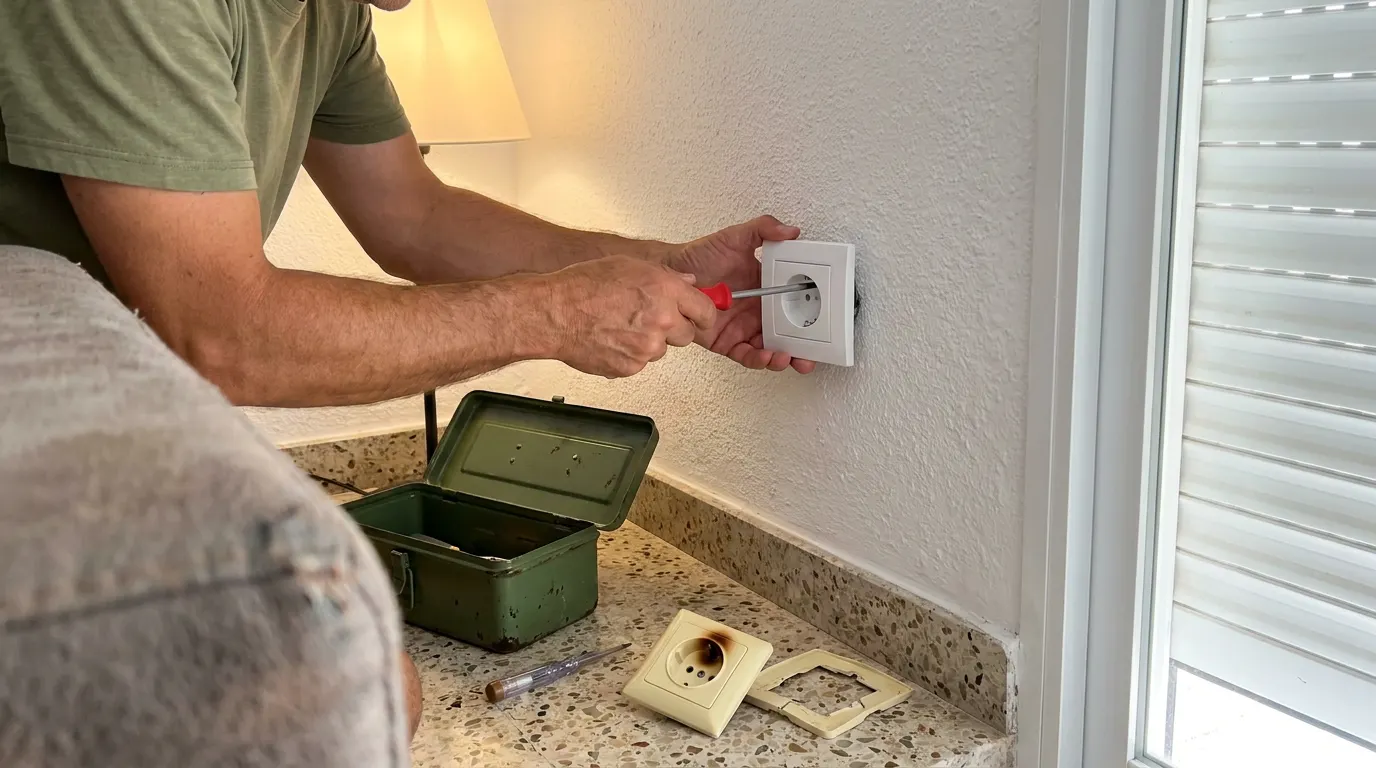
In 2026 an electrician in Valencia charges between 30 and 55 € an hour before VAT (IVA), plus 30-60 € for the call-out, according to industry guides. Replacing a socket or switch costs 25-60 €, a new fuse box (cuadro eléctrico) 300-800 €, and at night or on a public holiday the bill rises by between 25 and 50%.
That is the short answer.
The long one is about why two electricians with the same rate leave you with such different invoices, and which jobs anyone can do and which only an authorised installation company (empresa instaladora habilitada) can.
Octo Service is a repair service in Valencia and l'Horta: you tell us what is going on, we agree the price before anyone starts, and the work is done by an independent professional who works with us. The figures below are market prices, each with its source linked. These are not our rates.
How much does an electrician charge per hour in 2026?
Two recent price guides say almost the same thing. The Motor de Presupuestos guide, updated in June 2026, puts a senior electrician (oficial de primera) at between 40 and 55 € an hour, a second-grade one (oficial de segunda) at between 30 and 42 € and an assistant at between 22 and 30 €. The YOTU guide, from July 2026, gives 30-50 € an hour and 30-60 € for the visit or travel. Both before VAT.
| Item | 2026 market range (before VAT) | Source |
|---|---|---|
| Senior electrician, per hour | 40-55 € | Motor de Presupuestos |
| Second-grade electrician, per hour | 30-42 € | Motor de Presupuestos |
| Electrician per hour, general range | 30-50 € | YOTU |
| Call-out or travel | 30-60 € | YOTU |
| Surcharge for nights, weekends or public holidays | +25-50% | Motor de Presupuestos |
| Emergency call-out | 80-150 € or +30-50% | YOTU |
| Cost of a senior electrician's hour in the CYPE database | 25.52 € | CYPE |
Sources: Motor de Presupuestos, YOTU and the CYPE price generator. These are guide prices for the whole of Spain: the guides say Madrid, Barcelona and the Basque Country are above average, and Valencia is not on that list.
The last row needs explaining. CYPE is the price database architects and building surveyors use to cost building work, and its 25.52 € is what a senior electrician's hour costs on a large building site. It does not include the van, the tools, the insurance or the time spent in traffic on the V-30. That is why the hourly rate you pay at home is almost double: it is not a rip-off, it is the difference between working eight hours on one site and doing four separate call-outs in four neighbourhoods.
What you actually pay for: call-out, first hour, materials and VAT
A fair electrician's invoice can be read in four lines.
Call-out. In the city many include it; those who charge it separately ask what the table says. In the towns of l'Horta you almost always pay it.
A full first hour. It is the rule of the trade all over Spain. If your socket takes twenty minutes, you pay an hour. That is why the best-value trick is to group jobs: the socket that sparks, the hallway light and the switch that does not make contact, all in the same visit.
Materials. A basic socket or switch costs little. In the CYPE database, the socket base, cover and frame add up to 10.13 € of material. A residual current device (RCD, diferencial), about 55 €. If the quote just says “materials”, ask for them to be itemised.
VAT. Eleven points are at stake here. Repair and renovation work in a private home carries 10% instead of 21%, as long as the home is more than two years old and the materials supplied by whoever does the work are no more than 40% of the taxable base. The Spanish Tax Agency (Agencia Tributaria) explains it in its FAQ on building work, and the rule is article 91 of the VAT Act. Always ask “how much do I pay in total, with VAT”: almost all the ranges going around are before tax.
Prices per job: sockets, RCD, fuse box and boletín
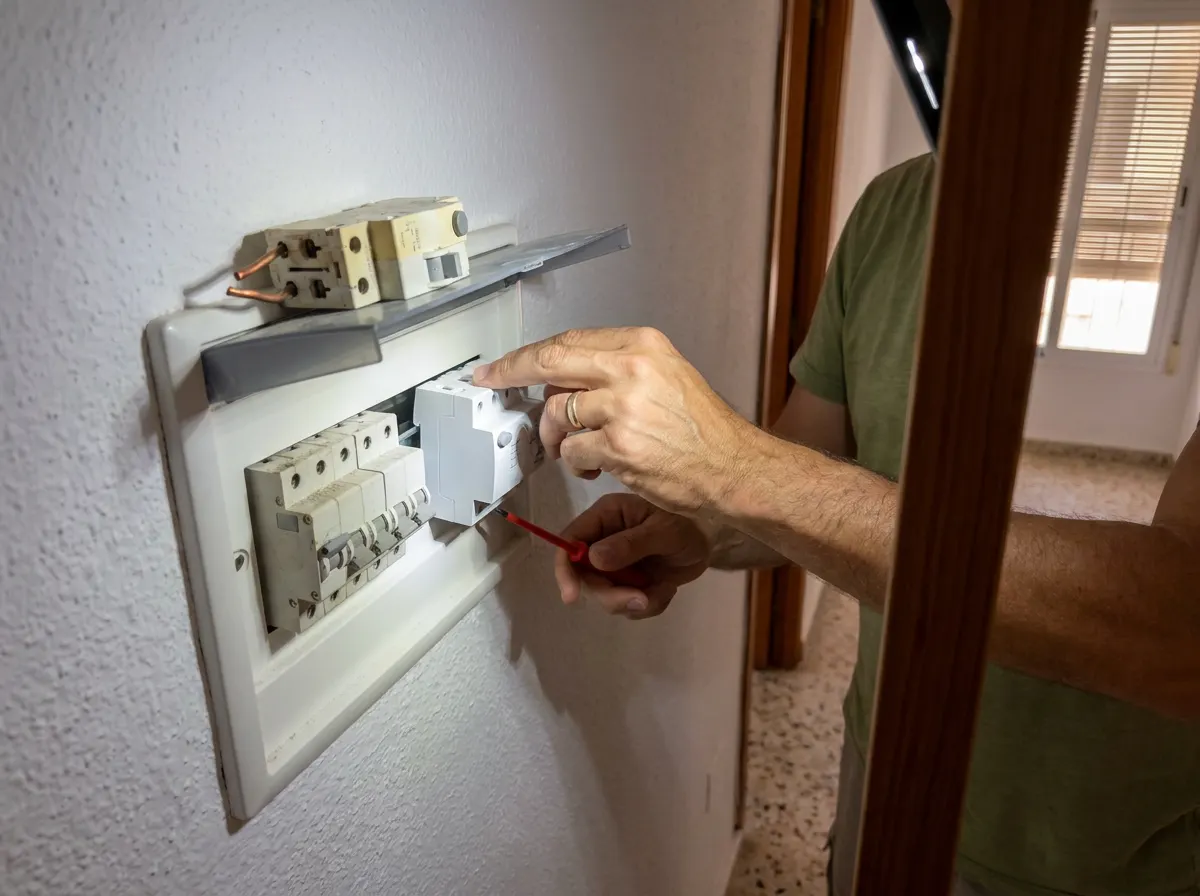
These are the published ranges for the jobs most often requested in a flat. Labour and basic materials, before VAT.
| Job | 2026 market range | CYPE reference (no call-out) |
|---|---|---|
| Replacing a socket or a switch | 25-60 € | socket 15.65 €, switch 15.77 € |
| Hanging a light on an existing light point | 35-65 € | - |
| New light point, with its cable | 40-150 € | - |
| Diagnosing and repairing a fault | 50-180 € | - |
| Replacing the RCD | - | 63.09 €, of which 55.01 € is material |
| New home fuse box | 300-800 € | - |
| Electrical installation certificate (boletín eléctrico, CIE) in Valencia, installation that already complies | 100-180 € | - |
| Complete rewiring, 80 m² flat | 2,500-4,500 € | - |
Sources: the socket, light point, fault and fuse box rows are from YOTU; the light and the 80 m² flat, from Motor de Presupuestos, which gives 350-700 € for the fuse box, within the same range. The CYPE references are for the socket, the switch and the 30 mA two-pole RCD. The boletín is broken down in how much the boletín eléctrico costs in Valencia.
Two useful ways to read this table.
First: the CYPE column is the floor. A fitted socket costs 16 € on a site where the electrician puts in forty in a row. In your home, just one, what counts is the call-out and the minimum hour. That is why replacing five sockets does not cost five times as much as replacing one.
Second: the guides give no market range of its own for the RCD, because it is almost never replaced on its own. Usually it trips, someone comes to see why, and swapping the part is the last step of a diagnosis. If the RCD is fine and what is failing is an appliance, such as the electric water heater (termo), the washing machine or a wet socket on the terrace, replacing it fixes nothing and the power will trip again. There, the line of the table that matters is “diagnosing and repairing a fault”.
Who can do each job?
This has more to do with your safety than with paperwork.
The Low Voltage Electrotechnical Regulation (Royal Decree 842/2002), in its instruction ITC-BT-03, defines the installation company as the one that carries out, maintains and repairs electrical installations. It is the only one that can sign the installation certificate, the boletín, and the only one you should let touch the fuse box.
In practice:
- Replacing a light fitting, a faceplate or a like-for-like socket or switch is minor maintenance. Lots of people do it with the power off and a screwdriver, and a careful handyman can do it.
- Fuse box, RCD, new lines, power increase or boletín are for an authorised installation company. Ask for its number before accepting the quote: a company in good standing gives it to you without batting an eyelid.
The same Regulation, in ITC-BT-25, requires a home installation to have a 30 mA RCD, which is what protects you from a shock. If your home does not have one, that is not a cosmetic detail: it is the first thing that should be fixed, and the first thing that will come up if you ever need a boletín.
A real emergency, or can it wait until tomorrow?
With a surcharge of 25 to 50%, it is worth thinking for a moment.
It is an emergency: a burning smell or a socket that is hot to the touch, sparks or smoke in the fuse box, a bare wire in sight, water near a socket or an appliance, and losing power in the whole home without any breaker in the fuse box having dropped (sometimes the problem is outside your flat, in the supply line or with the power company).
It can wait: a socket that does not work, a flickering light, a loose switch, an RCD that tripped once and stays up when you reset it. If you can cut the power to that part of the home by switching off a single breaker, switch it off and wait until tomorrow. If it is one dead socket, the socket not working test helps you work out whether it is the socket, the appliance or the fuse box.
We do not have a night service and we are not going to sell it to you as if we did. We deal with emergencies first, and if we cannot make it today we tell you straight.
What you can check yourself before calling
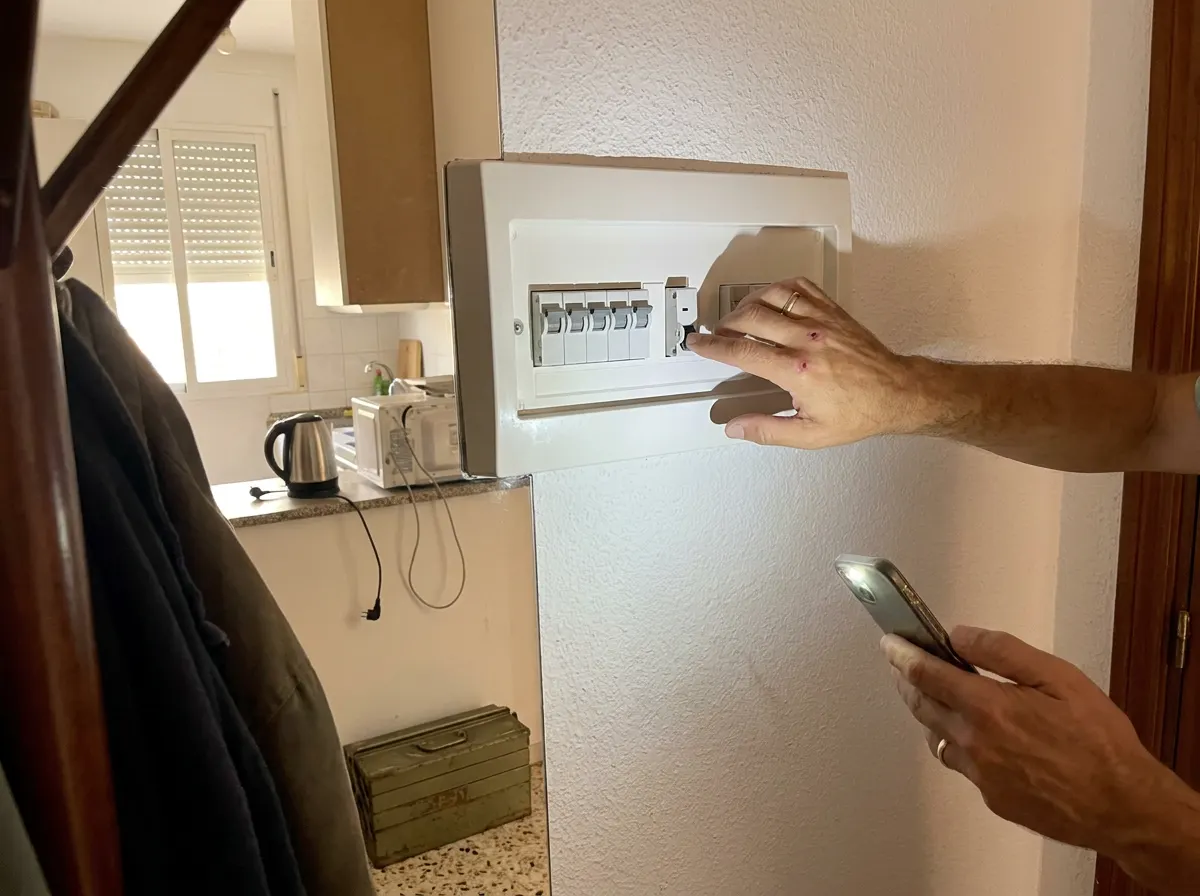
Two minutes in front of the fuse box sometimes save the whole visit, and always save diagnosis time.
- See what has dropped. If it is the RCD (the one with a test button), something has a leak to earth. If it is a circuit breaker (magnetotérmico), that circuit is overloaded or has a short circuit.
- Unplug everything on that circuit and push the breaker up. If it holds, plug things back in one by one. The one that trips it is the culprit, and very often it is the water heater, the washing machine or an extension lead on the terrace.
- If it will not hold even with everything unplugged, the problem is in the wiring. Now is the time to call, and tell the professional what you have tried.
If you want to go through it step by step, our “power keeps tripping” test takes you through these same questions and tells you whether yours is an appliance, the RCD or the contracted power (potencia contratada).
What you should not do: open the fuse box by taking the cover off, bypass an RCD that trips “so it holds”, or swap a breaker for one with more amps. The breaker is sized for the cable it protects; if you fit a bigger one, the thing that overheats is the cable inside the wall.
Signs of a quote you should avoid
- No figure at all over the phone. Not a range, not a minimum. From a photo of the fuse box and the socket, anyone can give you a ballpark figure.
- “The whole installation needs replacing” without anyone telling you what is wrong with yours. What does not comply can be explained in one sentence.
- Fuse box or boletín work without an installation company number.
- Cash only and no invoice. Without an invoice there is no reduced VAT, and no guarantee to claim.
And what you can always insist on: a total price in writing before work starts (a WhatsApp message is fine), an itemised invoice and the complaints form (hoja de reclamaciones), which in the Valencian Community those who provide services at home must carry too.
In Valencia and l'Horta: old flats and air conditioning
A local detail you will not find in the national guides. In Valencia and the ring of towns in l'Horta there are still many flats with the original wiring from when they were built, designed for a fridge, a washing machine and little else. Today those same flats have air conditioning in two rooms, an oven, an induction hob and an electric water heater.
You see the result in summer: the RCD or the main switch trips when the air conditioning and the oven run together. Sometimes it is the contracted power; sometimes everything hangs off the same circuit. To give you an idea, ITC-BT-10 of the Regulation now requires 9,200 W to be allowed for in a home with air conditioning. Wiring from fifty years ago was not designed for that, and that is why in these flats “just change the air conditioning socket” very often ends up as a new line from the fuse box.
The boletín procedure, on the other hand, is the same in Valencia city, Torrent or Paterna, because it belongs to the Generalitat (regional government). What changes between towns is the call-out fee.
A fixed price before anyone opens the fuse box
If you are in Valencia or l'Horta, send us a photo of what is not working, another of the fuse box with the cover on, and tell us which breaker drops and when. We send back a fixed price, usually in under 2 hours, with what is included and what is not. If something unseen turns up once it is opened, you get a new proposal and you decide. You will find the rest of the electrical jobs on the electrician in Valencia page.
Get your quote. Free, with no obligation.