





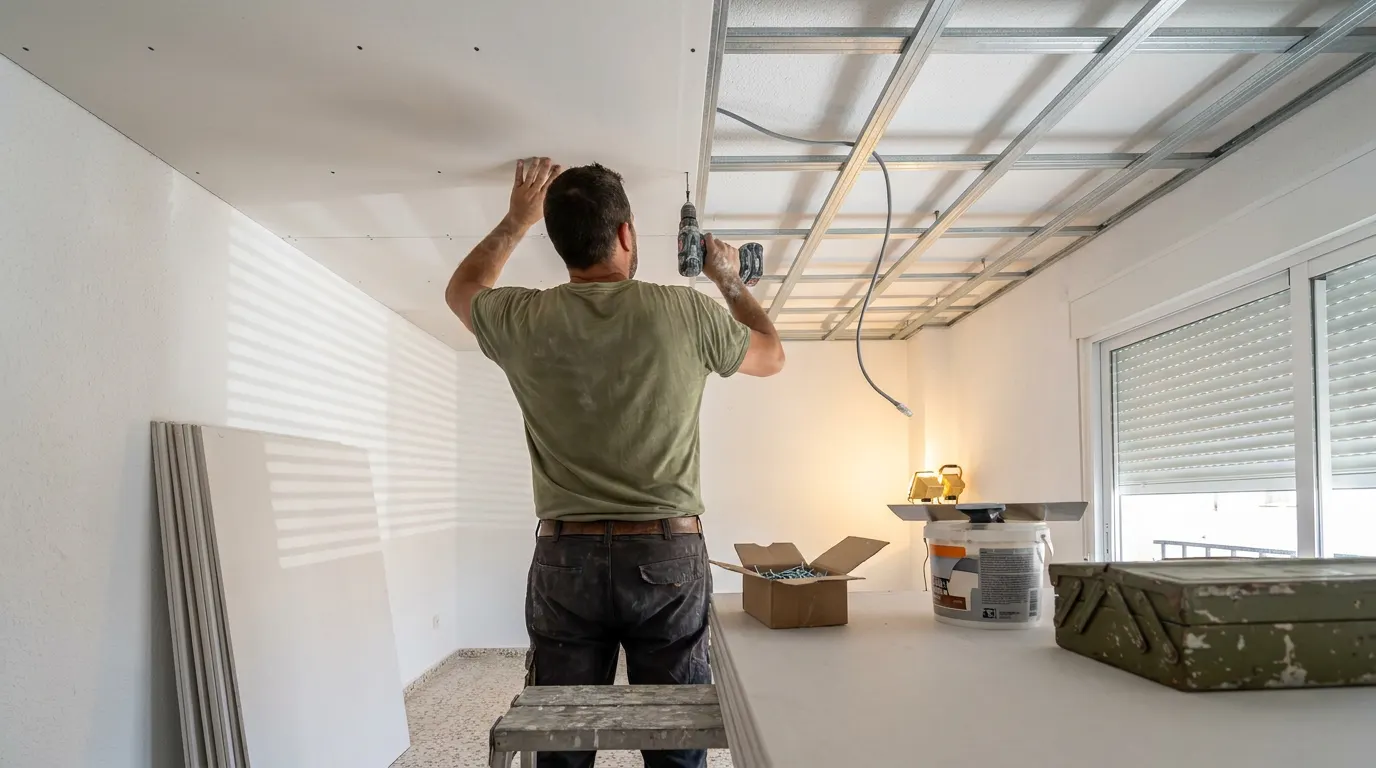
A plasterboard (pladur) false ceiling costs between 20 and 35 € per m² in 2026 if it is flat and smooth, with materials and labour. A suspended grid ceiling, between 20 and 45 €, and with an LED cove, around 40 €. A 25 m² living room comes to about 500-875 €. These are market ranges, not our rates.
In the bathroom, with moisture-resistant board, it goes up quite a bit more. For each range we tell you where it comes from, and we also give you the CYPE technical reference so you can see how much is material, how much is labour and how much is margin.
What moves the price most is not the type of ceiling but the size of the job. A 4 m² bathroom ceiling doesn't cost 4 times 30 €, and we explain why below.
How much does a plasterboard false ceiling cost per square metre?
The table brings two things together. The market range is what you see in quotes and comparison sites in 2026. The reference from the CYPE Generador de Precios, the price database architects and builders use in Spain, is direct cost before VAT (IVA) and without the margin of whoever does the job: the technical floor, not what you will pay.
| Type of ceiling | 2026 market range (guide) | CYPE reference, direct cost before VAT | What it's used for |
|---|---|---|---|
| Smooth flat ceiling, standard board | 20-35 €/m² | 27.08 €/m² (10.44 € material + 16.11 € labour) | lowering a ceiling, hiding pipes, a new ceiling in a living room |
| Suspended grid, 60 × 60 tiles | 20-45 €/m² | 28.17 €/m² | hallways and bathrooms with an air con unit or access points above |
| With built-in LED lighting (cove) | around 40 €/m², up to double a plain one | 20 cm vertical drop: 27.14 €/linear m, without the strip or the transformer | living rooms and bedrooms with indirect lighting |
| Moisture-resistant for bathroom or kitchen | above a normal flat ceiling; the green board costs more | 58.79 €/m², complete high moisture resistance system | bathroom and kitchen ceilings |
| Valencia and l'Horta | the same ranges | the same references | in older flats with high ceilings it is common to lower the ceiling to fit ducts |
Source: the market range is from the Habitissimo price guide for plasterboard false ceilings (16 September 2026: flat 20-35 €/m², removable 20-45 €/m², with LED lights up to double); the technical reference is from the CYPE Generador de Precios, linked row by row.
Three examples to give you an idea, using the market range for a flat ceiling:
- 12 m² bedroom: 240-420 €. Here the job minimum weighs a lot; we explain it further down.
- 25 m² living room: 500-875 €.
- Whole 70 m² flat: 1,400-2,450 €. With mineral wool insulation above the boards, a bit more.
If you already have the measurements, send them with a photo of the ceiling and we'll send back the number: ask for a plasterboard quote.
What the price per metre includes and what it doesn't
A properly stated price per m² for a false ceiling includes five things: the metal framing (the profiles and the hangers that drop from the floor slab above), the boards, the screws, the joint finishing with tape and compound, and the labour to put it all up. That is how CYPE breaks down its flat ceiling item. If you want to know how many boards, profiles and screws your ceiling needs, the plasterboard calculator counts them from the room's length and width.
What is usually not included, and worth asking about:
- Painting. The ceiling is handed over with the joints finished, ready to paint. Painting it is a separate item, sometimes by a different professional: what it covers is on the painter in Valencia page.
- Spotlights and electrics. Cutting the holes for the spotlights is usually included; fitting the lights, running cable and connecting them is an electrician's job.
- Insulation. Mineral wool above the boards, for sound or temperature. Quoted separately per m².
- Taking down the old ceiling. If there is old plaster (escayola) to remove, that is demolition and rubble.
- Vertical drops and level changes. The cove, a step around a beam or a box to hide a downpipe are charged per linear metre, not per m².
The split between material and labour is the key to the price: in CYPE's flat ceiling item, material is 10.44 € and labour 16.11 €. In other words, with plasterboard you mostly pay for hours of work. That is why a small ceiling is expensive per metre.
Flat or suspended grid: which one you need
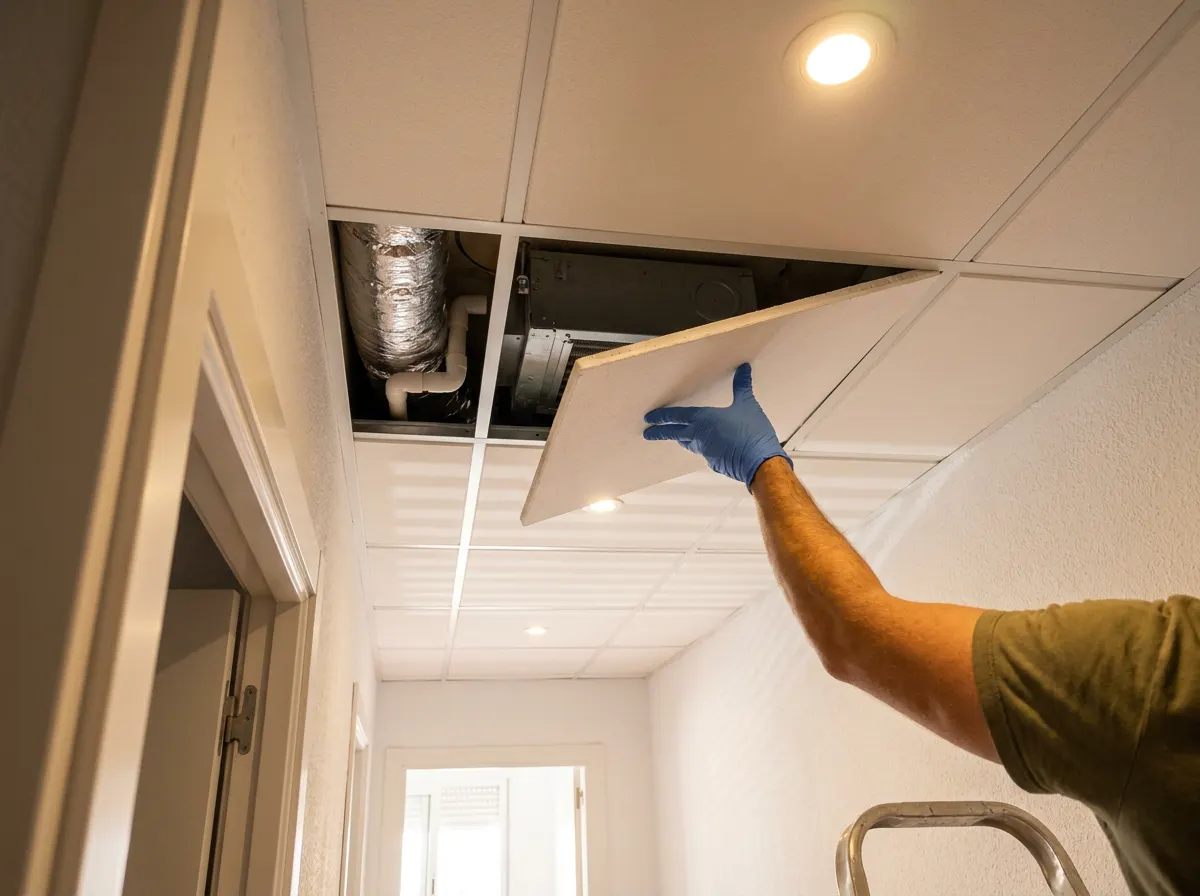
A flat (continuous) ceiling is the classic smooth ceiling with no visible joints: boards screwed to the framing, joints taped and filled, and ready to paint. It is the cheapest and the one that looks best in a living room or bedroom.
A suspended grid ceiling is made of 60 × 60 tiles resting on visible profiles. You can lift any tile by hand. It is chosen when there is something above that you will need to reach: a ducted air conditioning unit, stopcocks (llaves de paso), electrical junction boxes or the building's shared downpipe.
The rule of thumb: if there is nothing above to check, go flat. If there is, a suspended grid in that area, or a flat ceiling with an access hatch right under the unit. The hatch is more discreet, but the day the whole air con unit has to come out, you'll be glad of a grid ceiling.
If you are putting in ducted air conditioning, plan both jobs together: first the unit and ducts, then the ceiling. Prices for that installation are in our guide to what it costs to install air conditioning.
LED cove lighting: how much it adds
A cove (foseado) is the stepped edge around the ceiling where an LED strip is hidden to give indirect light. It looks great and it is one of the things that pushes the quote up most, for two reasons.
The first is that a cove is slow, linear work: cutting, fixing and taping the vertical drop (tabica) takes many more hours per metre than a flat surface. CYPE puts a 20 cm high vertical drop at 27.14 € per linear metre of direct cost, and almost all of it is labour: 24.71 € against 1.90 € of material.
The second is that the lighting is extra: the LED strip, the aluminium profile if you want one, the transformer and the connection, which an electrician does.
In market terms, a ceiling with built-in lighting can cost around 40 € per m², up to double a plain one. In a 4 × 4 metre room, a cove all the way round is 16 linear metres, and that is where the money goes, not on the flat part of the ceiling.
Which plasterboard goes in the bathroom?
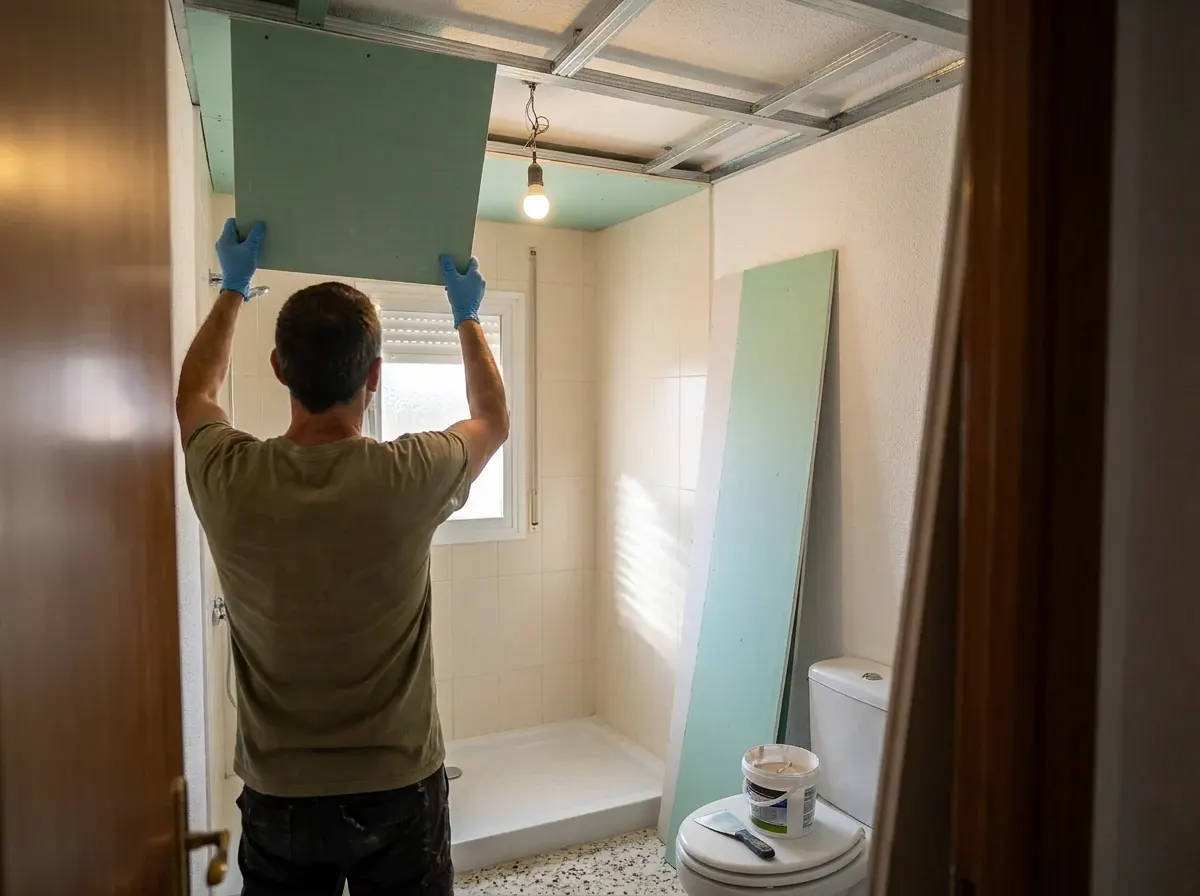
In bathrooms and kitchens, moisture-resistant board. It is the green one. The UNE-EN 520 standard, which classifies plasterboard, calls it type H: it has a treatment that reduces water absorption. The Pladur H1 board data sheet at a distributor recommends it precisely for bathroom and kitchen ceilings. The joints are finished with moisture-resistant compound as well.
Standard white board absorbs more water, and the ceiling of a bathroom with a shower is exactly where most steam builds up. A 4-5 m² bathroom takes two large boards; the difference between green and white is a few euros per board, so it isn't worth saving on.
CYPE puts a complete high moisture resistance flat ceiling at 58.79 €/m², more than double a normal flat ceiling. Careful, though: that item is a high-end system with glass-fibre board; ask which board and which framing you are getting, because that is where the price difference lies. And the bathroom has another problem: it is small.
The minimum charge: why a small ceiling is expensive per metre
According to CYPE's output rates, a tradesperson and an assistant put up a flat ceiling at 0.328 hours per m², that is, about 24 m² in an 8-hour working day. A 4 m² bathroom ceiling is just over an hour of fitting.
But the job doesn't end once the boards are screwed up. The joints get two coats of compound, and each has to dry before the next. That means two or three visits, each with its own call-out fee and its own time to set up and clear away. That is why almost nobody charges a bathroom ceiling at the per m² price: it is charged as a small job with its own minimum, and the price per metre comes out well above the table.
The advice that follows: if you have several ceilings to do (bathroom, hallway, kitchen), put them in the same quote. You pay the call-out fee and the drying time only once.
What VAT applies to a plasterboard false ceiling?
In a home for private use, normally 10%. Renovation and repair work on homes gets the reduced VAT rate as long as the materials supplied by the professional do not exceed 40% of the taxable base, according to the Agencia Tributaria FAQ on building work and repairs (Spain's tax agency).
With plasterboard that condition is usually met, because labour makes up more of the price than materials. But be careful: if the same quote includes insulation, spotlights, LED strips and special boards, materials can go over 40% and then the whole invoice is charged at 21%. If you rent the flat out, it is also 21%.
Ask them to tell you which VAT rate they are applying and why. And always ask for the total including VAT.
Plasterboard in Valencia: high ceilings and ducts
In Valencia plasterboard costs the same as in the rest of Spain. What changes is what it is used for.
In older flats in the centre, with high ceilings, it is very common to lower the ceiling in the hallway or bathroom to fit air con ducts or hide exposed pipes. In flats from the seventies and eighties, with lower ceilings, a false ceiling is used more to hide a downpipe, a beam or wiring, and then you need to look at how many centimetres you can afford to lose.
In both cases, the first question from whoever quotes you should be what is up there. If they don't ask it, ask them yourself.
Get a fixed price before work starts
At Octo Service we agree a fixed price in writing before work starts. You send us the room measurements, a photo of the current ceiling and tell us what you want (flat, suspended grid, with a cove, for the bathroom), and we send back the total price. The work is done by an independent professional who works with us in Valencia city and the towns of l'Horta.
There is more detail on the plasterboard in Valencia page, and if you're not sure whether we cover your street, check do we reach your home?.